Halloween feels like the perfect time to confront what really scares us — at least in our yards. From snakes to roots to buzzing bees, some of the biggest landscape “horrors” turn out to be perfectly natural (and even beneficial). Here are five fears we can finally put to rest before they come creeping back next spring.
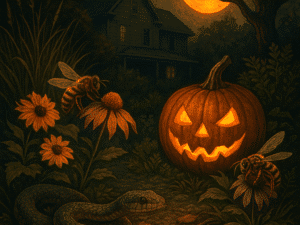
Few things send shivers down a new gardener’s spine like the thought of a snake in the flowerbed. But snakes aren’t drawn to specific plants — they’re drawn to habitat and food. Dense groundcovers or native grasses don’t attract snakes; they simply shelter insects, frogs, and small rodents that snakes eat.
Seeing a snake might just be a sign that your landscape is in ecological balance. Most species in North Texas are harmless and eager to avoid humans. They play a vital role in controlling rats and mice, which cause far more damage than the snakes ever will.
Keep beds tidy around walkways, store firewood off the ground, and let the back corners of your yard stay a little wilder. If you spot a snake, give it space — it’s proof your ecosystem is working as intended. So no need to shriek; the only thing “hiss-terical” here is how healthy your garden is.
It’s a fair question — but often asked for the wrong reason. As long as your home’s grading and drainage are correct, there shouldn’t be enough oxygen or moisture in the compacted soil beneath a slab to support root growth. Roots don’t seek to break concrete; they follow air and water. So the species of tree rarely matters.
A tree’s root system can spread two to three times its canopy width, so your neighbor’s established oak roots have already crossed the property line — but they’re thin, fibrous, and harmless.
The best practice is to plant trees at least half the mature canopy width away from structures, leaving a few extra feet so limbs don’t scrape the roof. Plant a live oak 25 feet from the house, not five. Properly sited trees actually help stabilize soil moisture and reduce foundation stress.
In North Texas, the real culprits of cracked foundations are the heavy clay “gumbo” soils that shrink and swell with moisture swings. Proper grading, compost and mulch, native plants, and drip irrigation are your best defenses against those soil-sucking ghouls.
This one has a grain of truth — but the order of events is backward. Roots don’t invade pipes unless there’s already a leak. A tree can’t sense moisture inside an intact line. Only when a crack or separation releases water into the soil do fine feeder roots move in to take advantage of what’s already leaking.
So yes, roots sometimes end up in pipes — but they didn’t cause the problem, though plumbers often incorrectly blame plants. They just found it. Routine maintenance and replacing old clay or cast-iron lines matter far more than where the nearest tree is planted.
Remember: roots can extend far past the drip line, so they’re likely already nearby — and perfectly harmless unless you’ve got a plumbing poltergeist of a leak.
It’s one of the most common requests at the nursery: “I want plants that attract butterflies, but not bees or wasps.” Nature doesn’t work that way. Most flowers welcome a wide range of visitors — bees, butterflies, moths, flies, hummingbirds, even beetles. While some blooms favor long-tongued pollinators, hungry bees adapt by “nectar robbing,” biting a small hole near the base of a flower to sip the reward inside.
Bees: Gentle Gardeners
Honeybees are almost never aggressive while foraging. They only sting when defending a hive or if actively harmed. Native bees are even milder — many can’t sting, and those that can rarely bother to. If they do, it’s so light it feels more like an itch. Seeing bees at work in your garden is a sign of success, not danger.
Wasps: Misunderstood and Underappreciated
Wasps get a bad rap, but most are either nectar feeders or beneficial predators that control pest insects like caterpillars, beetle larvae, grasshoppers, and aphids. Many wasps actually visit more flowers and can often be more effective pollinators than butterflies. The ones sipping nectar from your salvias or coneflowers aren’t plotting a sting — they’re fueling up for pest patrol. So don’t be spooked by the buzz; they’re your garden’s costumed superheroes.
Of all the landscape myths, this one might be the most unfounded. Native plants aren’t messy — though lazy design can be.
Even our Founding Fathers knew better. Thomas Jefferson filled the gardens at Monticello with native plants and edibles, partly because of his disdain for England and its ornamental traditions. George Washington’s Mount Vernon also celebrated native species in refined designs. Their gardens weren’t wild tangles — they were intentional, formal, and distinctly American.
Native plants can fit any design style — formal, modern, cottage, or naturalistic. Some naturally grow compact and orderly (think dwarf yaupon holly, dwarf wax myrtle, or compact autumn sage). Others can be easily shaped: pruning errant branches once or twice a year breaks apical dominance, encouraging dense, symmetrical growth.
If you want a tidy look, rely on repetition, a simple plant palette, and clean edges. Hardscape elements like straight-lined borders or paths instantly frame even wild plantings. And for HOA comfort, embrace the mullet landscape — business in the front (throw in three dwarf yaupons to calm the wild), party in the back. Keep the front beds formal and let your backyard go full prairie if you’d like.
Native plants aren’t the problem; they’re the palette. What you do with them defines the look — not where they came from.
Bottom line: Nature doesn’t have to be scary. The more we understand how living systems really work — from roots to reptiles — the more beauty and balance we invite into our landscapes.
Happy Haunt-ing Season from all of us at Rooted In.


ADDRESS:
12804 Pelzel Rd Pilot Point TX 76258
*Located off FM 455, about halfway between Celina and Pilot Point
CALL: 972.954.8580
TEXT: 972.954.8574

HOURS:
Tuesday – Saturday 9 AM – 5 PM
Sunday 10 AM – 5 PM