See FULL List at Bottom
If you live in North Texas, chances are you’ve experienced the frustration of planting something beautiful only to discover that wildlife thought it looked delicious.
For many gardeners, especially those living on acreage, in rural subdivisions, or along the edge of town, deer pressure can be a challenge in the landscape. Across Texas, new neighborhoods continue to expand into former pastureland, wooded creek corridors, and native habitat. As a result of this habitat loss, more homeowners are finding themselves sharing the landscape with white-tailed deer on a daily basis.
Drought can make the problem even worse.
White-tailed deer are browsers. Much of their diet consists of forbs—broadleaf flowering plants—as well as tender new growth on shrubs, vines, and trees. During periods of drought, the quantity and quality of natural forage often decline. When native vegetation becomes scarce or stressed, irrigated landscapes can suddenly become some of the most attractive feeding areas available.
That’s why deer often seem to appear overnight.
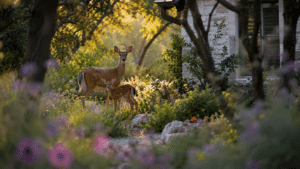
The good news is that while no plant is completely deer-proof, some plants are far less appealing than others.
Many native plants possess natural defenses that help reduce browsing pressure. Some produce strong-smelling foliage. Others have fuzzy leaves, tough fibrous foliage, bitter plant compounds, or physical defenses such as spines. Some simply grow so aggressively that they can recover from occasional browsing faster than deer can damage them.
Physical barriers are often the most effective protection for newly installed plants. Temporary fencing, wire cages, or exclusion netting can give plants time to establish before they face significant browsing pressure.
Repellents can sometimes provide short-term protection, particularly on newly planted material. However, products such as Deer Scram, predator urine, soap, human hair, and similar remedies typically require repeated applications and often lose effectiveness after rainfall, irrigation, or prolonged exposure to the elements.
In many cases, choosing the right plants is far more effective than trying to convince a hungry deer to change its mind.
Here are nine Texas native plants that deer usually leave alone.
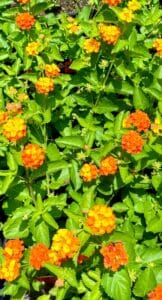
Size: 3–6 ft. tall × 3–6 ft. wide
Sun: Full sun
Foliage: Deciduous to semi-evergreen
Flowers: Orange, yellow, and red
Bloom Season: Late spring through frost
Deer Defense: Aromatic foliage and naturally occurring chemical compounds
Texas Lantana is one of the toughest native flowering perennials for North Texas. Once established, it thrives in heat, drought, reflected heat, and poor soils while producing months of colorful blooms.
The strongly aromatic foliage makes it much less appealing to deer than many common garden perennials. Its flowers also provide nectar for butterflies, native bees, and hummingbirds throughout the growing season.
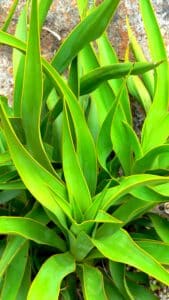
Size: 2–3 ft. tall × 3–5 ft. wide
Sun: Full sun to part sun
Foliage: Evergreen
Flowers: White to cream
Bloom Season: Late spring to early summer
Deer Defense: Tough fibrous leaves and physical defenses
Native to North Texas, Twistleaf Yucca is one of the most dependable deer-resistant plants available. The twisting blue-green foliage creates year-round interest while requiring very little maintenance.
Most deer simply aren’t interested in chewing through the tough, fibrous leaves. The dramatic flower stalks add seasonal interest and attract pollinators.
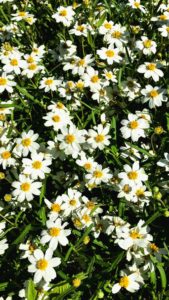
Size: 12–18 in. tall × 18–24 in. wide
Sun: Full sun
Foliage: Semi-evergreen
Flowers: White with yellow centers
Bloom Season: Spring through fall
Deer Defense: Aromatic foliage and coarse texture
Blackfoot Daisy has earned a loyal following among Texas gardeners because it blooms when many other plants are struggling. It thrives in hot, dry conditions and often flowers from spring well into fall.
Its foliage has a distinct scent and texture that deer generally avoid, making it one of the best low-growing native perennials for difficult sites.
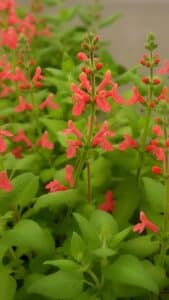
Size: 1–3 ft. tall × 2–4 ft. wide
Sun: Part sun to bright shade
Foliage: Semi-evergreen
Flowers: Red
Bloom Season: Spring through fall
Deer Defense: Fuzzy foliage and aromatic mint-family compounds
Texas Betony combines bright red flowers with surprisingly good deer resistance. The fuzzy leaves are less palatable than smooth foliage, and the plant’s mint-family chemistry provides another layer of protection.
It performs particularly well in partially shaded gardens and is a favorite of hummingbirds.
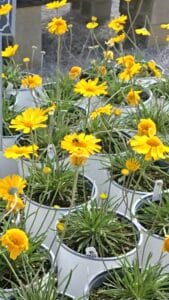
Size: 8–18 in. tall × 12–18 in. wide
Sun: Full sun
Foliage: Semi-evergreen
Flowers: Bright yellow
Bloom Season: Spring through fall
Deer Defense: Aromatic, resinous foliage
Few native perennials work harder than Four-Nerve Daisy. It tolerates drought, heat, poor soils, and reflected heat while producing cheerful yellow flowers for months.
The aromatic foliage and natural plant oils help make it a poor food choice for deer.
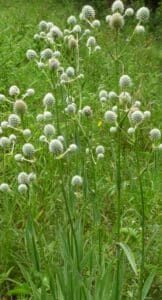
Size: 3–5 ft. tall × 2–3 ft. wide
Sun: Full sun
Foliage: Deciduous
Flowers: White to greenish-white
Bloom Season: Summer
Deer Defense: Tough, heavily lignified foliage
Rattlesnake Master may be one of the strangest-looking native perennials in Texas gardens. Its stiff, yucca-like leaves contain high levels of structural fibers that make them difficult and unappealing to browse.
The unusual flower heads support an astonishing diversity of beneficial insects and pollinators.
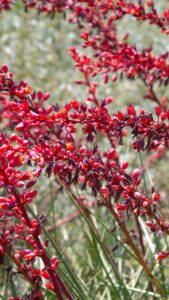
Size: 2–3 ft. tall × 3–4 ft. wide
Sun: Full sun
Foliage: Evergreen
Flowers: Red to coral pink
Bloom Season: Late spring through fall
Deer Defense: Tough, fibrous foliage
Despite its name, Red Yucca is not actually a yucca. It is, however, one of the most dependable landscape plants for North Texas.
The coarse foliage is generally ignored by deer, while the flower spikes attract hummingbirds for months.
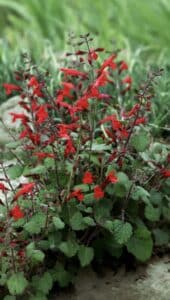
Size: 1–2 ft. tall × 2–3 ft. wide
Sun: Part shade to shade
Foliage: Semi-evergreen
Flowers: Bright red
Bloom Season: Spring
Deer Defense: Strongly aromatic foliage
One of the best native shade perennials in Texas, Cedar Sage thrives where many deer-resistant plants struggle. The aromatic foliage helps deter browsing while the flowers provide an important nectar source for hummingbirds and native pollinators.
It is particularly useful beneath trees and along woodland edges.
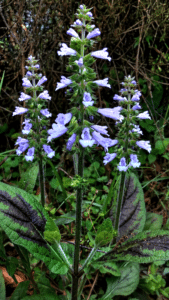
Size: 6–18 in. tall × spreading colony
Sun: Full sun to shade
Foliage: Semi-evergreen
Flowers: Blue-violet
Bloom Season: Spring
Deer Defense: Aromatic foliage and vigorous growth
Lyreleaf Sage takes a slightly different approach to deer resistance. While its foliage contains aromatic compounds that deer tend to avoid, its greatest strength may be its ability to spread and recover.
Once established, it can form attractive colonies that often outgrow occasional browsing pressure. It is also one of the most useful native groundcovers for difficult sites beneath trees.
The best goal might not be to completely eliminate deer from the landscape. White-tailed deer are a native and important part of Texas ecosystems, and many of gardeners enjoy seeing them from time to time.
The challenge is finding a balance between supporting native wildlife and protecting the landscape you’ve worked hard to create.
By choosing plants that deer generally avoid, protecting new plantings while they establish, and understanding that no plant is completely deer-proof, you can dramatically reduce browsing damage while still creating a landscape that supports birds, pollinators, and other wildlife.
That’s a win for both gardeners and the wildlife that share our corner of Texas.


Pick-up Locations (selected when checking out):
Arlington – 1100 SW Green Oaks Blvd., Arlington, TX 76017
Bedford – 2424 Forest Ridge Dr., Bedford, TX 76021
College Station – 13600 Rock Prairie Road, College Station, TX 77845
Fort Worth – 800 E Northside Drive, Fort Worth, TX 76102
Mansfield – 620 S Wisteria St, Mansfield, TX 76063
Pilot Point – 12804 Pelzel Rd, Pilot Point, TX 76258
Southlake – 1950 E. Continental Blvd., Southlake TX 76092

Fall Garden Pickup Date:
Saturday, September 26
9 AM – 11 AM
Instructions:
Stay in your vehicle—we’ll load your garden box for you.
Plants MUST be picked up at the pre-chosen date, time and location.
No rainchecks. No refunds. Unclaimed plants will be donated to a local community garden.
ADDRESS:
12804 Pelzel Rd Pilot Point TX 76258
*Located off FM 455, about halfway between Celina and Pilot Point
CALL: 972.954.8580
TEXT: 972.954.8574
HOURS:
Tuesday – Saturday 9 AM – 5 PM
Sunday 10 AM – 5 PM