From old-fashioned daffodils and spectacular ornamental onions to colorful tulips and even homegrown saffron, a little planning this fall can deliver months of colorful rewards.
Some of the best gardening decisions we make in fall won’t look like much when we make them. Take a flowering bulb, for instance. It’s not particularly attractive. Most resemble an oversized onion, while others look like something you might discover hiding in the back of your pantry. Yet beneath those papery coverings is a remarkable little package of stored energy, already preparing for next year’s flowers.
Plant it in the right place, at the right time, and you might be rewarded with a spectacular spring display. Choose wisely, and some bulbs will multiply and return year after year, long after you’ve forgotten exactly where you planted them.
But as with most things in North Texas gardening, there’s a catch.
Our unpredictable winters, heavy clay soils and occasionally stubborn autumn heat don’t always cooperate with plants accustomed to colder climates. Some flowering bulbs flourish here for generations, while others put on a magnificent performance their first spring and never return for an encore.
Timing matters, too. While October is prime planting season for most trees, shrubs and hardy perennials, certain spring-flowering bulbs are better left out of the ground until November or December.
At Rooted In, we’ve assembled an assortment of fall-planted bulbs ranging from dependable Southern garden favorites to unusual species with fascinating botanical, ecological and even culinary histories.
Here’s how to get the most out of them in a North Texas garden.
Most spring-flowering bulbs evolved in regions where winters are cool and summers are relatively dry. Their underground storage structures allow them to survive unfavorable conditions, then resume growth and flowering when the seasons change.
Some need prolonged cold temperatures to develop properly. Others rely more on seasonal rainfall, moisture and temperature changes.
That explains why planting everything on the same October afternoon isn’t necessarily the best strategy.
For gardeners in the Dallas–Fort Worth area, here’s the recommended schedule for our current selection:
| When to plant | What to plant |
|---|---|
| Now — October | Saffron crocus, red spider lily and bearded irises |
| October–November | Camassia and grape hyacinths as soils cool; paperwhites can be started indoors now |
| November–December | Daffodils and ornamental alliums |
| Thanksgiving–Christmas | Pre-chilled tulips |
There’s an important distinction here: planting something now doesn’t necessarily mean October is its ideal planting month.
For example, bearded iris rhizomes are generally best planted in late summer or early fall, while red spider lilies are traditionally transplanted during their spring and summer dormancy. Saffron crocus also benefits from late-summer or early-fall planting.
But if you’ve purchased these bulbs in October, there’s little benefit in holding them until December. Get them established now.
For many traditional spring-flowering bulbs, especially daffodils, ornamental alliums and tulips, it’s better to wait until soils have cooled. Temperatures around 55°F or lower are a useful indication that conditions are becoming more favorable, although requirements vary by species.
And when it comes to tulips, we’ve already taken care of one particularly important step: chilling.
More on that below.
Before planting anything, it’s worth considering what’s beneath our feet.
North Texas is home to several distinct soil regions. Dominated by soils of the Blackland Prairie contains deep, fertile, often alkaline clays that can become sticky and saturated after heavy rainfall, then shrink and crack during summer droughts.
Meanwhile, smaller portions of the Eastern Cross Timbers feature sandier, faster-draining soils that behave quite differently.
Both can support beautiful flowering bulbs. The trick is understanding what each plant needs.
Most bulbs require adequate drainage, particularly while dormant. In saturated soils, oxygen becomes limited and the underground storage structures become more vulnerable to decay.
That’s a particular concern for tulips, saffron crocus and many ornamental alliums.
In heavy clay, raised planting beds, elevated berms or containers with drainage holes can make a significant difference. Compost incorporated throughout an entire bed can gradually improve soil structure, but simply digging a hole in clay and filling it with loose potting mix or gravel doesn’t fix a drainage problem. It may actually create a pocket where water collects.
It’s also worth remembering that most bulbs already contain much of the energy they need for their first season’s growth. There’s no reason to automatically add fertilizer to every planting hole. If you’re planning a large perennial bulb planting, a soil test is a better starting point.
With that groundwork covered, let’s look at the plants themselves.
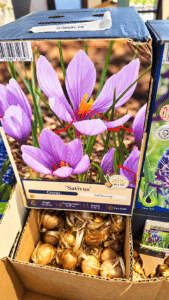
Crocus sativus
Blooms: October–November | Height: 4–8 inches | Sun: Full sun
Few plants have had such an extraordinary influence on human history while occupying so little garden space.
Saffron crocus produces delicate lavender-purple flowers containing three vivid red stigmas—the pollen-receiving structures harvested and dried to make the world’s most expensive spice!
Saffron has flavored and colored food for thousands of years, appearing in dishes ranging from Spanish paella to Persian rice and Moroccan tagines. It has also been prized historically as a dye, medicine and symbol of luxury.
Its extraordinary price comes largely from the labor involved in harvesting it. Each flower produces just three red stigmas, and roughly 150 flowers or more may be needed to produce a single gram of dried saffron.
The plant itself is considerably easier to grow than the spice is to harvest.
Unlike spring-flowering crocuses, saffron crocus blooms in autumn. Technically, it grows from a corm, a swollen underground stem similar in function to a bulb.
Plant corms approximately 4 inches deep and 4 inches apart in full sun and exceptionally well-drained soil. They appreciate moisture during active autumn and winter growth but need relatively dry conditions during summer dormancy.
In North Texas, a sunny raised bed or container is often preferable to poorly drained clay.
Ideally, saffron crocus should be planted in late summer or early fall. October is toward the end of that window, so plant promptly, understanding that new corms may not produce flowers until a subsequent autumn.
The plant’s grasslike foliage remains active through cooler weather before disappearing as temperatures rise.
And an important word of caution: Our genuine saffron comes from the red stigmas of properly identified Crocus sativus. Don’t confuse it with Colchicum, another fall-flowering plant sometimes called autumn crocus or meadow saffron, which is highly poisonous.
Only properly identified saffron stigmas should be harvested for food.
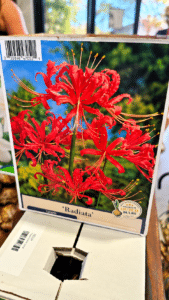
Lycoris radiata
Blooms: Late August–October | Height: 12–24 inches | Sun: Full sun to partial shade
If you’ve spent much time exploring old North Texas neighborhoods or country roads, you’ve probably seen red spider lilies without knowing their name.
These brilliant red flowers often appear around old homesites, along fences and beneath mature trees, sometimes decades after the original gardeners have moved on.
They’re also called hurricane lilies or equinox flowers, references to their habit of flowering in late summer and early fall, often following seasonal rainfall.
And their appearance is anything but ordinary.
The flowers emerge on seemingly naked stalks, each carrying clusters of bright red blossoms with narrow, recurved petals and long stamens resembling spider legs.
Then comes the unusual part.
Instead of producing leaves before flowering, red spider lilies develop their strap-shaped foliage afterward. That foliage remains green through the cooler months, gathering energy before disappearing in spring.
The plant spends much of the summer completely hidden underground.
Red spider lilies originated in East Asia but have become well established in Southern gardens, including North Texas.
They thrive in partial shade or morning sun, particularly beneath deciduous trees that allow sunlight to reach their winter foliage. Well-drained soil is important, although established plants tolerate periods of summer dryness.
Plant bulbs approximately 6–12 inches apart, with their necks at or slightly above the soil surface.
While spring and summer dormancy is generally the preferred time for transplanting these bulbs, October purchases should be planted promptly.
Don’t be surprised if they take a season or two to settle in before flowering.
Unlike many modern tulips, red spider lilies are capable of becoming long-lived garden residents, gradually forming larger colonies over time.
Their flowers can attract butterflies and other nectar-seeking insects during late summer and fall.
They’re also poisonous, so keep them out of the kitchen.
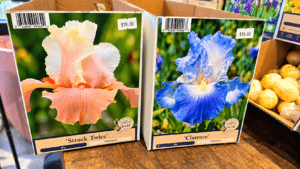
Iris Tall Bearded Hybrids
Blooms: Primarily April–May, with possible fall rebloom | Height: 35–37 inches | Sun: Full sun
Few flowers are as closely associated with old-fashioned Southern gardens as bearded irises.
Their dramatic, ruffled blooms come in an extraordinary range of colors, and their swordlike foliage provides an architectural element even when they’re not flowering.
Technically, these aren’t bulbs at all. They grow from rhizomes, thickened stems that spread horizontally near the soil surface.
That distinction matters because bearded irises should be planted much more shallowly than most traditional bulbs.
In fact, the upper surface of the rhizome should remain exposed or barely covered. Bury it too deeply, particularly in North Texas clay, and you’re inviting rot and poor flowering.
Bearded irises prefer full sun, good drainage and soils that are neutral to slightly alkaline. They’re particularly well suited to the chemistry of many Blackland Prairie soils, provided excess water can drain away.
Our two varieties also have another interesting characteristic: both are classified as reblooming irises.
‘Clarence’ produces beautifully ruffled flowers with white standards lightly tinted violet and soft blue-violet falls—the downward-facing portions of an iris flower. Its fragrance is another welcome feature.
Growing approximately 35 inches tall, ‘Clarence’ has documented rebloom reports from Texas through the American Iris Society. That’s encouraging, although a second display isn’t guaranteed every year.
‘Struck Twice’ offers a completely different color combination, with soft pink upper petals, deeper azalea-pink falls and vivid orange-red beards.
This fragrant cultivar reaches approximately 37 inches tall and is also registered as reblooming.
Both cultivars are garden hybrids derived from Eurasian ancestry, not North American natives. Their flowers may attract larger bees, but they aren’t established local butterfly host plants. The rhizomes and other plant parts are not edible.
Late summer through September is the preferred time for planting and dividing bearded irises in our region, but October planting remains reasonable.
Give each rhizome approximately 12–18 inches of space and allow its foliage to remain healthy after flowering. Established clumps can be divided every few years to maintain vigor.
For gardeners seeking relatively dependable perennial color, bearded irises remain hard to beat.
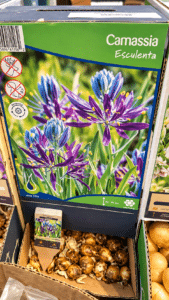
Camassia esculenta
Blooms: Spring, generally April–May | Height: Approximately 12–30 inches, depending on species | Sun: Full sun to partial shade
Of all the bulbs in our collection, camassia has one of the most interesting connections to North American history.
Also called camas or wild hyacinth, these plants produce graceful spikes of blue, violet or occasionally white star-shaped flowers above narrow, grasslike foliage.
Long before European settlement, camas was an important traditional food for numerous Indigenous communities, particularly in the Pacific Northwest.
Certain species were gathered and slowly cooked in earth ovens, transforming their stored carbohydrates into sweet, nourishing food. Harvesting and preparing camas was an important part of many communities’ seasonal food traditions.
One historical application refers to western camas, Camassia quamash, native to western North America. Another refers to Camassia scilloides, an eastern and central North American species whose native range includes Texas.
Camassia behaves differently from many of the Mediterranean bulbs in our collection.
Rather than demanding especially dry conditions throughout its growing season, camas appreciates consistent moisture (compost amended soils) during active spring growth, followed by a comparatively drier summer dormancy. (no problem there!)
Plant the bulbs approximately 4–6 inches deep in fertile, moist but well-drained soil. Full sun or light shade is suitable.
In North Texas, a sunny bed that retains some spring moisture without becoming waterlogged is worth trying.
Whether these particular bulbs will naturalize dependably in our climate remains uncertain until their identity and local performance are better established.
Camassia flowers can provide pollen and nectar for spring bees and other insects, making them interesting additions to ecologically diverse gardens.
Camassia is more than an attractive North American wildflower. Its bulbs are edible and were an important traditional food for numerous Indigenous communities, especially in the Pacific Northwest. Species such as Camassia quamash were harvested and slowly roasted or boiled, transforming their carbohydrate-rich bulbs into sweet, nourishing food. Eastern camas, Camassia scilloides, also has edible bulbs. However, camas can be confused with highly poisonous death camas, so accurate identification is essential before harvesting or consuming any bulbs.
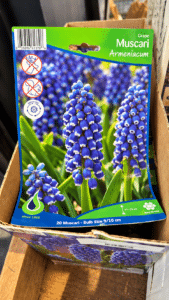
Muscari armeniacum
Blooms: February–April | Height: 6–9 inches | Sun: Full sun to partial shade
Some of the best spring flowers come in surprisingly small packages.
Grape hyacinths produce dense clusters of tiny cobalt-blue, bell-shaped flowers, often tipped with delicate white edges. From a distance, each spike resembles a miniature bunch of grapes.
Despite the name, they’re not true hyacinths. They belong to the genus Muscari, native to portions of southeastern Europe and western Asia.
Plant these little bulbs approximately 2–3 inches deep and 3 inches apart in well-drained soil.
They look particularly attractive planted in generous drifts beneath deciduous trees, along pathways or among larger yellow daffodils.
They also offer something beyond good looks.
Grape hyacinths can provide nectar and pollen for early-season bees at a time when flowering resources are still relatively limited. The Royal Horticultural Society recognizes Muscari armeniacum for its pollinator value.
Grape hyacinths are known for naturalizing in North Texas homesteds. Once established, they can produce offsets and sometimes spread by seed, gradually forming colorful colonies.
In particularly favorable conditions, they may spread more enthusiastically than expected, so choose their location accordingly!
Late October through December is a suitable planting period, once soil temperatures begin cooling.
Grape hyacinths have a surprisingly rich culinary history. In southern Italy, the bulbs of a related species, Muscari comosum, are traditionally boiled, pickled or preserved as lampascioni. The culinary connection extends to Muscari armeniacum, the species we’re carrying, whose bulbs have been documented as a traditional spice in eastern Turkey. Although these historical food uses are well documented, ornamental nursery bulbs shouldn’t be consumed without confirming their identity, preparation requirements and treatment history.
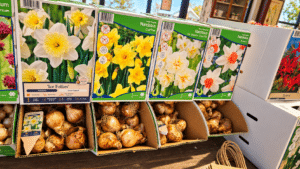
Narcissus cultivars
Blooms: Generally February–April | Height: 12–20 inches | Sun: Full sun to partial shade
It’s difficult to imagine a spring garden without daffodils.
Their cheerful flowers have become synonymous with the end of winter, but their appeal goes beyond appearance. Many are long-lived, relatively unappealing to deer and rodents, and capable of persisting for generations in suitable Southern landscapes.
The key is choosing the right varieties.
Not every daffodil sold nationally is well adapted to our winters. Some need more chilling than North Texas consistently provides, while others perform beautifully with relatively little attention.
Texas A&M AgriLife-affiliated Ellis County Master Gardeners specifically recommend two of the varieties we’re carrying: ‘Carlton’ and ‘Ice Follies’.
‘Carlton’ is the classic golden-yellow daffodil, producing large flowers with broad yellow petals and prominent cups. Growing approximately 14–18 inches tall, it’s a vigorous variety and one of the better candidates for naturalizing in North Texas.
‘Ice Follies’ offers a softer combination of creamy-white petals and a broad pale-yellow cup that gradually fades toward white. It’s another vigorous selection with favorable regional recommendations, often reaching 14–18 inches tall.
‘Accent’ introduces something less traditional: creamy-white petals surrounding a delicate salmon-pink cup. Its unusual coloring provides a welcome contrast among purple grape hyacinths or blue spring flowers. Growing approximately 16–18 inches tall, it’s an attractive variety, although its long-term North Texas naturalizing performance is less established than ‘Carlton’ or ‘Ice Follies’.
‘Sir Winston Churchill’ looks more like a miniature bouquet than a conventional daffodil. Its fragrant, double flowers combine creamy white petals with orange accents, often appearing in clusters on each stem. Growing approximately 14–18 inches tall, it’s especially appealing as a cut flower.
There’s an ecological distinction worth noting here.
And despite their resemblance to familiar edible onions, daffodil bulbs are poisonous, as are other parts of the plant.
For our area, November through December is a good target, although planting dates can vary with autumn conditions.
Choose a sunny, well-drained location and plant bulbs with their pointed ends upward. Most standard daffodil bulbs are planted approximately 4–6 inches deep, depending on bulb size and soil conditions.
Plant them in irregular groups rather than straight lines for a more natural appearance.
Daffodils can perform well beneath deciduous trees because their foliage receives sunlight before the trees fully leaf out.
And perhaps the most important maintenance tip of all: don’t cut back their leaves immediately after flowering.
Those leaves are still photosynthesizing, replenishing the stored energy needed for next year’s blooms. Allow the foliage to yellow naturally before removing it.
This simple practice can make a tremendous difference in whether perennial bulbs continue flowering year after year.
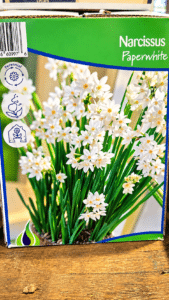
Narcissus papyraceus and related paperwhite selections
Blooms: Approximately 4–6 weeks after indoor planting; winter to early spring outdoors | Height: 12–20 inches | Sun: Bright indoor light or full sun outdoors
Paperwhites belong to the same genus as daffodils, but they have a distinctly different personality.
Their clusters of delicate white flowers are famously fragrant, although that fragrance can be surprisingly divisive.
Some folks love it.
Others find it a tad overwhelming.
Either way, few flowering bulbs are easier to bring into bloom indoors.
Unlike tulips, paperwhites don’t require an extended period of artificial chilling before flowering.
Simply place them in a container filled with potting mix or decorative stones, provide moisture and bright light, and watch them grow.
When using pebbles, keep the water level near the base of the bulbs rather than submerging them. Too much water can encourage decay.
Paperwhites often bloom within four to six weeks, making them popular for holiday decorations and winter centerpieces.
Like all narcissus, paperwhites are poisonous and should never be eaten.
For indoor gardeners, though, they’re a wonderful way to enjoy a little spring color before winter has even finished.
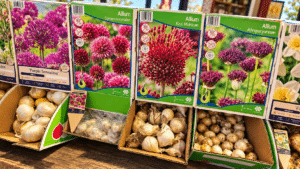
Allium species and cultivars
Blooms: Generally late spring through early summer, depending on species | Height: 18–40 inches | Sun: Primarily full sun
If you’re familiar with onions, garlic and chives, you’ve already met some members of the genus Allium.
But their ornamental relatives take flowering to another level.
Imagine perfectly rounded purple globes floating above a perennial border, deep burgundy flower clusters resembling miniature fireworks, or delicate green-and-pink bells suspended from tall stems.
These remarkable plants offer an impressive range of flower shapes, colors and sizes.
They also have something else going for them: many are attractive to bees and other flower-visiting insects.
Alliums are particularly useful for extending a garden’s flowering season beyond the earliest spring bulbs.
Most require full sun and excellent drainage, although some tolerate partial shade.
In North Texas, November through December is an appropriate planting window for the spring-flowering ornamental alliums in our collection.
The five varieties we’re offering are quite different from one another.
Allium hollandicum ‘Purple Sensation’
Growing approximately 24–36 inches tall, ‘Purple Sensation’ produces dense, spherical clusters of vivid rosy-purple flowers.
Each globe contains dozens of tiny star-shaped blossoms, creating an architectural display that looks almost too perfect to be real.
This award-winning cultivar is especially attractive when planted among lower-growing perennials that help conceal its foliage as it begins to yellow.
The Royal Horticultural Society recognizes ‘Purple Sensation’ for its nectar and pollen value to pollinating insects.
Its primary drawback in North Texas is the need for excellent drainage, especially during dormant periods. Plant it in a raised bed or other well-drained site rather than consistently wet clay.
Allium amethystinum ‘Red Mohican’
For something a little more unusual, ‘Red Mohican’ produces wine-red flower clusters with a distinctive tufted crown.
Some flowers near the top are carried on elongated stalks, giving the cluster an almost whimsical appearance. The individual flowers may open with pale or whitish coloring before developing richer tones.
Growing approximately 30–40 inches tall, this Mediterranean-origin ornamental onion works beautifully among ornamental grasses and flowering perennials.
Its unusual flower structure makes it particularly interesting for cut arrangements.
Full sun and well-drained soil are essential.
Like its culinary relatives, ‘Red Mohican’ belongs to the edible onion genus. The leaves of Allium amethystinum are documented as edible, while its bulbs and flowers share the characteristic onion-family chemistry. Although the cultivar is grown primarily for its unusual burgundy blooms, its botanical relationship to familiar kitchen vegetables adds another layer of interest.
Allium atropurpureum
As its scientific name suggests, this species produces remarkably dark flowers.
Its rounded to slightly flattened clusters contain numerous deep wine-purple or burgundy blossoms, creating a striking contrast against silver foliage, yellow flowers or ornamental grasses.
Growing approximately 20–30 inches tall, it’s especially attractive in naturalistic perennial borders.
Unlike the tightly packed spheres of ‘Purple Sensation’, its flower heads have a more open appearance.
Native to portions of southeastern Europe and western Asia, it prefers full sun and well-drained soil, with comparatively dry conditions during dormancy.
Like other edible members of the onion genus, Allium atropurpureum has culinary uses beyond its ornamental appeal. Its small bulbs and leaves can be eaten raw or cooked, while the dark purple flowers are recorded as an edible garnish. The species offers an interesting combination of striking garden color, pollinator value and potential culinary interest.
Allium sphaerocephalon
This is one of the more versatile ornamental alliums.
Rather than producing oversized spheres, drumstick alliums develop smaller, oval-shaped flower heads that begin green before gradually changing to rich reddish-purple.
Their slender stems, generally 18–30 inches tall, sway gracefully above surrounding vegetation.
They also tend to flower later than many large ornamental alliums, extending their usefulness to visiting bees into early summer.
Drumstick alliums are well suited to sunny, relatively lean, well-drained soils and are worth experimenting with in naturalistic plantings.
Drumstick allium isn’t just an ornamental relative of the onion. Its bulbs and leaves are edible, with a characteristic onionlike flavor, while its small purple flowers can also be used as an edible garnish. The species has a documented history of food use, including its bulbs being consumed in parts of Siberia. It’s another example of how a plant grown primarily for its flowers can have a culinary side.
Allium siculum, formerly Nectaroscordum siculum
Of all the ornamental onions in this collection, Sicilian honey garlic might be the most unusual.
Instead of producing rounded flower heads, it develops loose clusters of dangling, bell-shaped blossoms in subtle shades of cream, green and dusty pink or purple.
As the flowers fade, their stalks gradually turn upward, creating equally interesting seed heads.
Growing approximately 30–48 inches tall, this Mediterranean species tolerates full sun to partial shade and prefers moderately fertile, well-drained soil.
Its flowers offer nectar resources for bees and other insects, and established plants may multiply or self-seed where conditions are favorable.
It’s an excellent choice for gardeners who appreciate plants that look a little different from everything else in the neighborhood.
Mediterranean bells also has an intriguing culinary connection. In Bulgaria, the leaves of a regional form of Allium siculum are traditionally used to make samardala, a strongly flavored seasoning prepared with salt and dried herbs. Its delicate, dangling flowers are also described as edible. Although it belongs to the onion genus, its bulbs are much less familiar as a food than those of cultivated garlic or onions.
Sometimes, but this is where realistic expectations matter.
Ornamental alliums are botanically perennial, and many return reliably in climates with colder winters and dry summers.
Our combination of often warmer winters, intense summer heat and occasional prolonged rainfall can make their performance less predictable.
Some species may establish and persist year after year in sunny, sharply drained locations, while others might gradually decline if we get a string of mild winters and brutal summer heat.
For gardeners working with heavy clay, raised beds and containers can definitely improve the odds.
Plant bulbs approximately two to three times as deep as their height, adjusting for the species and soil conditions.
And remember that ornamental alliums aren’t native to North America. Although many provide useful nectar or pollen, their value as larval host plants for North Texas butterflies shouldn’t be assumed.
Tulipa cultivars
Blooms: Generally late winter through early spring in North Texas, often March–April | Height: 16–24 inches | Sun: Full sun
If there’s one flowering bulb that deserves a little extra attention in North Texas, it’s the tulip.
Few flowers can compete with its extraordinary colors and elegant form. Yet the same tulips that flourish across much of Europe and the northern United States can be frustratingly inconsistent here.
The problem isn’t necessarily our summer heat. It’s also our winters.
Modern garden tulips typically require an extended period of cold temperatures (vernalization) to develop properly and produce strong flowers.
Our winters don’t always provide enough consistent chilling to meet those requirements.
That’s why all five tulip varieties currently available at Rooted In have been pre-chilled and are being kept refrigerated until planting time.
This treatment helps satisfy their chilling requirements before they go into the ground.
Customers won’t need to complete a separate chilling process, provided the bulbs have received adequate pre-chilling.
But that doesn’t mean they should be planted immediately.
For North Texas, we generally recommend planting pre-chilled tulips between Thanksgiving and Christmas, once soil temperatures have dropped.
Until then, keep them refrigerated, ideally around 35–45°F, with adequate ventilation and away from ripening fruit. Apples and other fruits release ethylene gas, which can interfere with flower development.
We’ve selected five varieties offering distinctly different colors and flower forms.
Tulipa ‘Strong Gold’
A classic Triumph tulip with large, golden-yellow, cup-shaped blooms.
Growing approximately 16–18 inches tall, ‘Strong Gold’ produces sturdy stems and bold spring color.
It’s particularly effective planted in generous groups alongside purple grape hyacinths or darker tulip varieties.
Its strong, traditional flower shape also makes it useful for cutting gardens.
Tulipa ‘Sarah Raven’
This elegant lily-flowered tulip offers something quite different from the traditional cup-shaped bloom.
Its deep burgundy flowers have long, pointed petals that curve outward, creating a graceful, almost star-shaped appearance when fully open.
Growing approximately 18–22 inches tall, it’s particularly attractive in mixed spring arrangements.
The Royal Horticultural Society has recognized its distinctive coloring, long flowering period and attractive flower form in its plant trials.
Tulipa ‘Negrita’
For gardeners who appreciate rich purple flowers, ‘Negrita’ is an excellent choice.
This Triumph tulip produces large, goblet-shaped blossoms in shades of violet-purple, sometimes displaying warmer magenta tones as the flowers open.
Growing approximately 18–24 inches tall, it makes a striking companion to yellow daffodils or the golden blooms of ‘Strong Gold’.
It’s also a beautiful cut flower.
Tulipa ‘Dynasty’
‘Dynasty’ brings a softer color palette to the spring garden.
Its sturdy, cup-shaped flowers combine delicate blush-pink petals with creamy-white to pale-yellow coloring near their bases.
Growing approximately 18 inches tall, this Triumph tulip is particularly attractive in cottage-style gardens, containers and mixed floral arrangements.
Pair it with ‘Negrita’ for a striking contrast between rich purple and soft pink.
Tulipa ‘Flaming Flag’
Some tulips look almost hand-painted, and ‘Flaming Flag’ is a perfect example.
Its creamy-white flowers are streaked with vivid violet-purple markings, creating a dramatic flamed appearance.
This Triumph tulip grows approximately 16–18 inches tall and offers excellent visual interest when planted in groups.
The striking pattern resembles the famous broken tulips that once captured Europe’s imagination, but ‘Flaming Flag’ is a modern ornamental cultivar rather than a plant that needs a virus to produce its distinctive coloring.
Once soils have cooled, plant tulips approximately 6 inches deep, measured from the soil surface to the bottom of the bulb, and 4–6 inches apart.
Choose a location receiving at least six hours of direct sunlight during the growing season.
Good drainage is essential. Raised beds and containers are particularly useful in heavy clay.
For the most attractive display, plant tulips in clusters rather than scattering individual bulbs throughout the landscape.
Water after planting to settle the soil, then provide moisture as needed during unusually dry winter and spring conditions. Avoid keeping the planting area consistently saturated.
And there’s one final point worth emphasizing.
In North Texas, most modern hybrid tulips are best treated as seasonal annuals.
Although botanically perennial, many don’t receive the environmental conditions needed to flower dependably in subsequent years.
Some may return with foliage but few flowers but the vast majority are one and done.
For reliable spring color, planting fresh, properly chilled bulbs each fall is generally the best strategy.
As mentioned above, some of the most interesting bulbs in our collection have culinary histories that extend far beyond their ornamental use.
Saffron crocus is perhaps the most famous example. Its three brilliant red stigmas produce the spice that has flavored dishes from Spain to India for centuries.
Camassia offers another fascinating connection to food history. Long before European settlement, Indigenous communities throughout western North America harvested camas bulbs, traditionally slow-roasting them to develop their characteristic sweetness. Proper identification remains essential because poisonous death camas can resemble edible camas.
Even our familiar grape hyacinths have a culinary connection. In southern Italy, the bulbs of Muscari comosum are prepared as lampascioni, a traditional regional specialty often pickled or preserved in olive oil. Research in eastern Turkey has also documented the bulbs of Muscari armeniacum, the species we’re carrying, being used as a spice.
Then there are the ornamental alliums.
These flowering relatives of onions, garlic and chives are more than colorful additions to the garden. Drumstick allium (Allium sphaerocephalon) has edible bulbs, leaves and flowers, while Allium atropurpureum also has documented edible uses.
Mediterranean bells (Allium siculum), sold under the older name Nectaroscordum, has a particularly interesting culinary tradition in Bulgaria, where the leaves of a regional form are used to prepare a strongly flavored seasoning called samardala.
Even tulips have occasionally found their way into the kitchen. Their petals have been used as edible garnishes, although their bulbs contain compounds capable of causing illness.
Of course, not every beautiful bulb belongs on the dinner table.
Daffodils, paperwhites, red spider lilies and bearded irises contain toxic compounds and should never be eaten.
And there’s one important distinction between a species having edible uses and a commercially purchased ornamental bulb being suitable for consumption. Ornamental bulbs may have been treated with products not approved for food crops, and traditional food plants sometimes require specific preparation methods.
For gardeners, the culinary history of these plants offers yet another reason to appreciate them—even when their primary purpose is simply to make the landscape more beautiful.
If there’s one thing experience teaches us about growing bulbs in North Texas, it’s that the right plant in the right place usually matters more than any fertilizer, amendment or gardening trick.
Choose species suited to the amount of sunlight your landscape receives. Improve drainage where necessary. Plant at the correct depth, remembering that iris rhizomes and certain lilies are exceptions to the usual rules.
Avoid excessive irrigation while bulbs are dormant, but don’t neglect plants during periods of active root and leaf growth.
And whenever possible, let foliage die back naturally after flowering.
Those fading leaves may not be the prettiest part of the garden, but they’re doing important work underground, helping replenish the reserves that support future blooms.
It’s also worth deciding what you want from your planting.
If your goal is a long-lived, low-maintenance display, start with locally proven choices such as red spider lilies, bearded irises, grape hyacinths and dependable daffodils like ‘Carlton’ and ‘Ice Follies’.
If you enjoy experimenting, saffron crocus, camassia and unusual ornamental alliums offer plenty of possibilities.
And if you’re after a spectacular burst of spring color, there’s nothing wrong with treating tulips as annuals and enjoying every minute of their relatively brief performance.
Not every plant needs to live forever to earn its place in the garden.
Perhaps the best thing about planting bulbs is the anticipation.
We tuck a rather ordinary-looking package into the ground during autumn, then trust that something remarkable is happening beneath the surface.
Weeks pass. Temperatures fluctuate. Winter arrives, or at least our North Texas version of it.
Then one morning, seemingly overnight, a few green shoots appear where there was nothing before.
Soon come the daffodils, grape hyacinths, irises and tulips, followed by the remarkable flowering alliums. And as summer gives way to fall, red spider lilies return to remind us that the bulb season never really ends.
Some of these plants may become lasting features of the landscape, multiplying and spreading for generations. Others will simply offer a beautiful seasonal display.
Both are worthwhile.
At Rooted In, we’ve selected our fall bulb collection to give North Texas gardeners opportunities to enjoy familiar favorites, explore unusual plants and create more diverse, colorful landscapes.
Whether you’re planting your first daffodils, experimenting with homegrown saffron or planning a showstopping display of pre-chilled tulips, now is the time to make a plan.
Just remember, not every bulb belongs in the ground on the same day.
Some are ready to plant now. Others, especially our pre-chilled tulips, are best planted after Thanksgiving.
After all, gardening has always been something of a long game.
And sometimes the best rewards come to those who are willing to wait.
Rooted In
12804 Pelzel Road, Pilot Point, TX 76258
Tuesday–Saturday: 9 AM–5 PM
Sunday: 10 AM–5 PM
We’re always happy to help you select the right bulbs for your growing conditions and find the best place for them in your garden.


Pick-up Locations (selected when checking out):
Arlington – 1100 SW Green Oaks Blvd., Arlington, TX 76017
Bedford – 2424 Forest Ridge Dr., Bedford, TX 76021
College Station – 13600 Rock Prairie Road, College Station, TX 77845
Fort Worth – 800 E Northside Drive, Fort Worth, TX 76102
Mansfield – 620 S Wisteria St, Mansfield, TX 76063
Pilot Point – 12804 Pelzel Rd, Pilot Point, TX 76258
Southlake – 1950 E. Continental Blvd., Southlake TX 76092

Fall Garden Pickup Date:
Saturday, September 26
9 AM – 11 AM
Instructions:
Stay in your vehicle—we’ll load your garden box for you.
Plants MUST be picked up at the pre-chosen date, time and location.
No rainchecks. No refunds. Unclaimed plants will be donated to a local community garden.
ADDRESS:
12804 Pelzel Rd Pilot Point TX 76258
*Located off FM 455, about halfway between Celina and Pilot Point
CALL: 972.954.8580
TEXT: 972.954.8574
HOURS:
Tuesday – Saturday 9 AM – 5 PM
Sunday 10 AM – 5 PM