Everybody loves butterflies. But caterpillars? Apparently, they need to die immediately.
I see this contradiction constantly. We plant a “pollinator garden,” celebrate when butterflies begin visiting, and then discover something chewing holes in the leaves and immediately start looking for a pesticide. But here is the uncomfortable part: Sometimes the holes are the point.
One of my favorite sayings is: “If nothing is feeding on your garden, then you are doing something wrong.” That does not mean we should allow every pest to run rampant through our landscapes. It means that the goal of a healthy garden should not be perfection. The goal should be balance.
A truly successful landscape is not just a collection of beautiful plants. It is an ecosystem. Plants feed insects. Insects feed birds. Flowers feed pollinators. Leaves become food, shelter, and places to reproduce. Predators help control prey. Everything participates. And sometimes participation looks like a chewed-up plant.
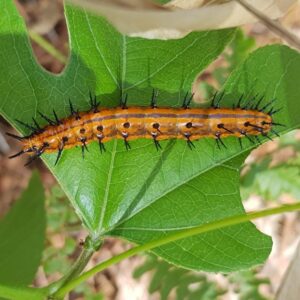
Recently, a client sent me photos of their passionvine. It had been practically stripped of its leaves, and understandably, they were panicking. They thought something was killing the vine and were worried they were going to lose it. The culprits were Gulf fritillary caterpillars. And they were not evidence that something had gone wrong. They were evidence that something had gone right.
Passionvines are host plants for Gulf fritillaries. The adult butterfly lays its eggs on the vine, and when those eggs hatch, the caterpillars eat. And eat. And eat. They can eat so aggressively that a passionvine can look terrible for a while, and then the next week, the vine looks as if nothing happened with fresh new growth.
Think about that for a moment. We plant passionvine because we want butterflies. Then the caterpillars arrive and use the plant for exactly the ecological purpose we hoped it would serve, and our first instinct can be to kill them because they are making the plant ugly.
We cannot ask nature to show up and then complain when it starts eating.
A butterfly garden is not simply a collection of pretty flowers where adult butterflies stop by for photographs. A butterfly has an entire life cycle: egg, caterpillar, chrysalis and finally butterfly. If we only provide nectar for the adult butterfly but eliminate the caterpillars eating our plants, we have not really created butterfly habitat. We have created a restaurant with no nursery.
Of course, there are destructive pests that require management. Gardening with nature does not mean ignoring genuine problems. It means identifying what you are looking at before deciding it needs to die.
That caterpillar might become the butterfly you were hoping to attract.
That chewed leaf might be feeding something.
That hole might mean your garden has become habitat.
And that slightly imperfect plant may be doing far more ecological work than the untouched one next to it.
We have spent decades teaching homeowners that a successful landscape should look flawless: perfect leaves, perfect lawns, no insects, no weeds, no blemishes. But nature does not look like that. Nature has bite marks.
Building a balanced ecosystem means accepting a little imperfection. It means understanding that your garden is not only there for you. When we invite wildlife into our landscapes, occasionally they are going to eat the landscaping.
So, the next time you walk outside and discover holes in a leaf, do not immediately reach for the spray bottle. Look closer. Identify what’s eating. Ask what role it plays. Because sometimes those holes are not evidence of a gardening problem.
Sometimes they are evidence that you have finally built a garden worth eating.
And if we want butterflies, occasionally we are going to have to buy lunch.


Pick-up Locations (selected when checking out):
Arlington – 1100 SW Green Oaks Blvd., Arlington, TX 76017
Bedford – 2424 Forest Ridge Dr., Bedford, TX 76021
College Station – 13600 Rock Prairie Road, College Station, TX 77845
Fort Worth – 800 E Northside Drive, Fort Worth, TX 76102
Mansfield – 620 S Wisteria St, Mansfield, TX 76063
Pilot Point – 12804 Pelzel Rd, Pilot Point, TX 76258
Southlake – 1950 E. Continental Blvd., Southlake TX 76092

Fall Garden Pickup Date:
Saturday, September 26
9 AM – 11 AM
Instructions:
Stay in your vehicle—we’ll load your garden box for you.
Plants MUST be picked up at the pre-chosen date, time and location.
No rainchecks. No refunds. Unclaimed plants will be donated to a local community garden.
ADDRESS:
12804 Pelzel Rd Pilot Point TX 76258
*Located off FM 455, about halfway between Celina and Pilot Point
CALL: 972.954.8580
TEXT: 972.954.8574
HOURS:
Tuesday – Saturday 9 AM – 5 PM
Sunday 10 AM – 5 PM