Shade gardening in Texas gets a bad reputation.
For a lot of homeowners, “shade garden” means that awkward spot under the oak tree where grass refuses to grow, the soil stays compacted, and every plant from the big box store seems to slowly disappear by August. Add in heavy clay, tree root competition, reflected heat from fences and foundations, and it can feel like you’re landscaping in hard mode.
But shade doesn’t have to be where plants go to struggle—it can be one of the most beautiful, layered, and ecologically valuable parts of your landscape.
The secret is simple: stop fighting the conditions and start planting for them.
Texas native plants already know how to handle these spaces. Many evolved in woodland edges, understories, creek corridors, and shaded prairies. They tolerate heat, clay, drought, and competition far better than many traditional “shade plants,” while also feeding birds, butterflies, hummingbirds, and native bees.
Here are 9 native shade plants we love for Texas gardens.
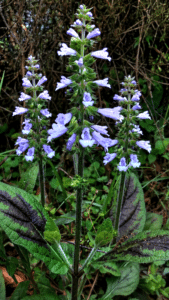
Lyreleaf Sage is one of the best problem-solvers you can plant in shade.
It’s a dependable Texas native groundcover that spreads vigorously in spots where nothing else wants to grow—bald patches, muddy areas, transition zones beneath trees, and places where turf grass has officially given up. Instead of constantly trying to force grass to survive, Lyreleaf Sage creates a living mulch that looks intentional and supports the ecosystem.
Its soft blue-violet spring flower spikes provide nectar for native bees and early pollinators, while the foliage adds texture and structure long after bloom season.
This is one of those plants that quietly fixes bad landscaping decisions.
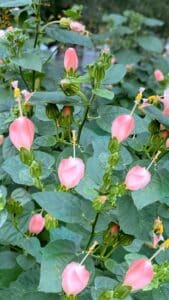
If you only planted one native shade perennial in Texas, Turk’s Cap would make a strong argument.
It handles deep shade beautifully, thrives through brutal summer heat, and keeps blooming when many other plants tap out. Most people know the classic red form, but it also comes in pink and white for a softer, more refined look depending on your style.
Hummingbirds absolutely love it, but so do butterflies and native bees. It gives you lush, tropical-looking foliage with the toughness of a true Texas native.
That combination is hard to beat.
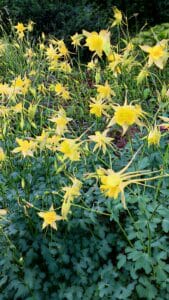
Columbine brings something shade gardens often lack—early spring excitement.
Before summer perennials wake up, Columbine is already putting on a show with cheerful yellow blooms that brighten woodland beds and shady borders. It performs beautifully in part shade and feels especially at home tucked beneath trees or along garden edges with morning sun.
It’s also an excellent early nectar source for hummingbirds and pollinators, helping support wildlife when blooms can still be limited.
Sometimes the best garden moments happen before summer even starts.
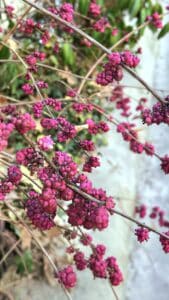
Coralberry is an underrated native shrub that deserves more attention.
It handles shade well and creates soft, natural structure beneath trees where many shrubs struggle. Its arching branches give it a graceful look, and if those branches touch the ground, they often re-root—allowing it to slowly form a colony over time.
That makes it feel almost like a creeping shrub.
Its pink berries provide an important late-season food source for birds, while the flowers support native bees and other pollinators. It’s a plant that quietly works hard year-round.
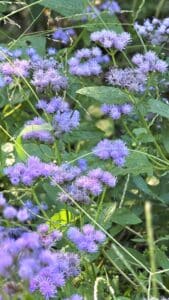
If your goal is butterflies, Blue Mistflower belongs on the list.
This plant thrives in part sun down to nearly full shade and produces electric blue flowers that absolutely light up the late-season garden. Queens, monarchs, and countless other butterflies use it as a major nectar source, while native bees work it constantly.
It brings movement, color, and life to shaded borders and woodland gardens in a way few plants can.
When it’s blooming, people notice.
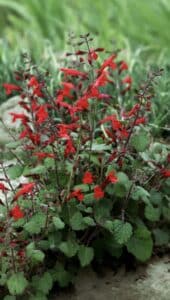
Cedar Sage feels like it belongs in every native shade garden.
It’s a true Texas woodland native, naturally growing beneath trees and along shaded edges where conditions can be tough. Its bright red flowers stand out beautifully in spring and provide an early nectar source for hummingbirds, butterflies, and native pollinators.
It adds bold seasonal color exactly where most gardens need it most.
There’s something satisfying about a plant that looks like it was always meant to be there.
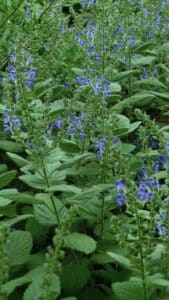
Heartleaf Skullcap is a quieter plant—but a very smart one.
It handles fairly deep shade, thrives in woodland settings, and offers fuzzy gray-green foliage that adds soft texture even when it isn’t blooming. In mild winters, it stays semi-evergreen, which makes it especially valuable in shade gardens where structure matters.
Its purple-blue flowers support native bees and small pollinators in spring and fall, while the plant often goes dormant during the peak of summer heat before returning strong in cooler weather.
It rewards patience.
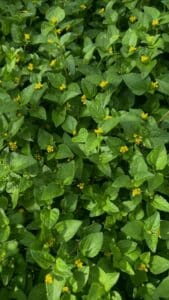
Horseherb might be one of the most useful native plants in Texas.
It creates a soft green carpet in dry shade and deep shade beneath established trees—exactly where traditional turf usually fails. Instead of fighting for a perfect lawn, Horseherb gives you a living groundcover that feels natural, durable, and low maintenance.
Its small yellow flowers provide subtle nectar for pollinators, while the dense cover helps protect soil and improve habitat.
Sometimes the best answer is to stop trying to force grass.
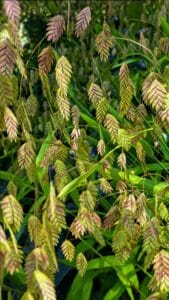
Every shade garden needs movement, and Inland Sea Oats brings it.
This native ornamental grass thrives in bright shade and woodland edges, with graceful arching seed heads that catch light, wind, and attention. It softens hard lines in the landscape and adds the kind of texture that makes gardens feel layered and alive.
It also readily reseeds, helping form a natural groundcover over time, while the seeds provide food for birds and small wildlife.
It’s one of those plants that makes a garden feel finished.
Even native shade plants perform better when planted with intention.
Most of these plants prefer well-prepared soil with good drainage, even in shade. Lightly amending clay with compost and expanded shale can help improve structure without overcomplicating things. Tree roots, compacted soil, and standing water are often bigger problems than lack of fertility.
A slight slope or micro hill can make a huge difference.
Mulch helps regulate soil temperature and retain moisture, but once these plants are established, most require surprisingly little supplemental irrigation. The goal is not to create a high-maintenance shade bed—it’s to create a resilient one.
Let the plants do the heavy lifting
Shade gardens shouldn’t feel like the leftover space in your landscape.
They should feel intentional, layered, and alive.
When you stop treating shade like a problem and start planting for what actually wants to grow there, everything changes. Birds show up. Butterflies stay longer. Hummingbirds find your garden. And those frustrating bare spots under the trees start to feel like opportunities instead of failures.
These nine native plants prove that some of the best parts of a garden happen in the shade.
📍 Rooted In — 12804 Pelzel Rd. Pilot Point, TX
We specialize in Texas native and well-adapted plants built for real-world conditions!


Pick-up Locations (selected when checking out):
Arlington – 1100 SW Green Oaks Blvd., Arlington, TX 76017
Bedford – 2424 Forest Ridge Dr., Bedford, TX 76021
College Station – 13600 Rock Prairie Road, College Station, TX 77845
Fort Worth – 800 E Northside Drive, Fort Worth, TX 76102
Mansfield – 620 S Wisteria St, Mansfield, TX 76063
Pilot Point – 12804 Pelzel Rd, Pilot Point, TX 76258
Southlake – 1950 E. Continental Blvd., Southlake TX 76092

Fall Garden Pickup Date:
Saturday, September 26
9 AM – 11 AM
Instructions:
Stay in your vehicle—we’ll load your garden box for you.
Plants MUST be picked up at the pre-chosen date, time and location.
No rainchecks. No refunds. Unclaimed plants will be donated to a local community garden.
ADDRESS:
12804 Pelzel Rd Pilot Point TX 76258
*Located off FM 455, about halfway between Celina and Pilot Point
CALL: 972.954.8580
TEXT: 972.954.8574
HOURS:
Tuesday – Saturday 9 AM – 5 PM
Sunday 10 AM – 5 PM